
A young player gets up to 600% more touches on the ball in a futsal match than in a full-size outdoor game. Read that again. Six hundred percent. That single number is why so many of the best players in the world grew up on futsal courts long before they ever stepped onto a big grass field.
Most parents in Kansas City have never heard the word. That is starting to change fast. Futsal is the small-sided, fast-paced indoor version of soccer, and it may be the single most underrated skill-builder your child can play. If your kid loves soccer but their touch or confidence feels stuck, this is the article that explains why futsal could be the missing piece.
What is futsal, exactly?
Futsal is a five-a-side game played on a hard court about the size of a basketball court, with a smaller, heavier, low-bounce ball. That last detail matters more than it sounds. The low-bounce ball stays on the ground and rewards clean, controlled touches instead of big booming kicks.
The court is smaller. The teams are smaller. The ball barely bounces. Add all of that together and you get a game where every single player is constantly involved. There is nowhere to hide and no time to stand around. Compare that to an eleven-a-side outdoor match, where a young defender might touch the ball a handful of times in an entire half.
The sport is recognized by FIFA and governed in the United States through US Youth Futsal. This is not a watered-down indoor knockoff. It is a distinct discipline with its own World Cup, and top soccer nations use it as their primary youth development tool.
The skill that changes everything: more touches
The whole case for futsal comes down to repetition under pressure. Skills are built through reps, and futsal delivers an avalanche of them. Research on ball involvement shows players get more than 200% more touches in a futsal match than in a typical indoor game, and up to 600% more than outdoors.
Every one of those touches happens in a tight space, with a defender closing in, inside a real game situation. That combination is what separates a player who looks great in drills from one who performs when it counts. Think about what it means over a season. A kid who plays futsal weekly stacks thousands of extra decisions on top of their normal training. They learn to receive on the half-turn, shield the ball, and release a pass in a fraction of a second. Those instincts do not come from cones. They come from reps in chaos, and futsal is organized chaos.
Four ways futsal sharpens young players
Beyond raw touch count, futsal develops a specific set of qualities that carry straight over to the outdoor game.
Close control and quick feet
The tight court forces players to master the ball in small spaces. There is no room to take a heavy first touch and chase it down. Kids learn to keep the ball glued to their feet and manipulate it with both feet out of necessity. This is the same close control that shows up as elite dribbling on a full field.
Faster decision-making
In futsal the game never pauses. Transitions from attack to defense happen in a blink, so players are constantly reading the court and choosing their next move before the ball even arrives. That mental speed is one of the hardest things to teach, and futsal teaches it through the game itself rather than through a whiteboard.
Confidence for quieter players
This one gets overlooked. Futsal is a fantastic setting for a shy or less physically dominant kid to grow. On a big field a timid player can drift to the wing and disappear for forty minutes. On a futsal court they are always in the action, forced to touch the ball and make plays. We have watched reserved kids come out of their shell in a matter of weeks once they cannot fade into the background.
Better fitness and agility
The stop-start, high-intensity nature of futsal is a serious workout disguised as fun. Players are constantly accelerating, decelerating, and changing direction, which builds the same explosive quickness that dedicated speed and agility training targets. It is a natural complement to structured conditioning work.
What age is best to start futsal?
Futsal delivers value at almost every youth age, but the sweet spot for skill development is roughly ages 6 through 12. This is the window where the brain and body are wiring in fundamental motor patterns, and the high-touch environment speeds that process up dramatically.
Younger kids, even at 5 and 6, benefit from the constant involvement and the simple joy of always being near the ball. Older players and teens use futsal to sharpen their first touch in ways full-field training rarely allows. Many serious young athletes play outdoor soccer in their primary season and add futsal alongside it to keep developing year round. If you are weighing whether your kid has what it takes for the next level, our guide on whether your child will make the club team pairs well with a futsal-based plan.
Getting started with futsal in Kansas City
The beautiful thing about futsal is that it does not care about the weather. Kansas City summers are brutal and the winters are worse, but an indoor court runs twelve months a year, rain, snow, or 100-degree heat. That makes it one of the most reliable ways to keep a young player developing when outdoor fields are unusable.
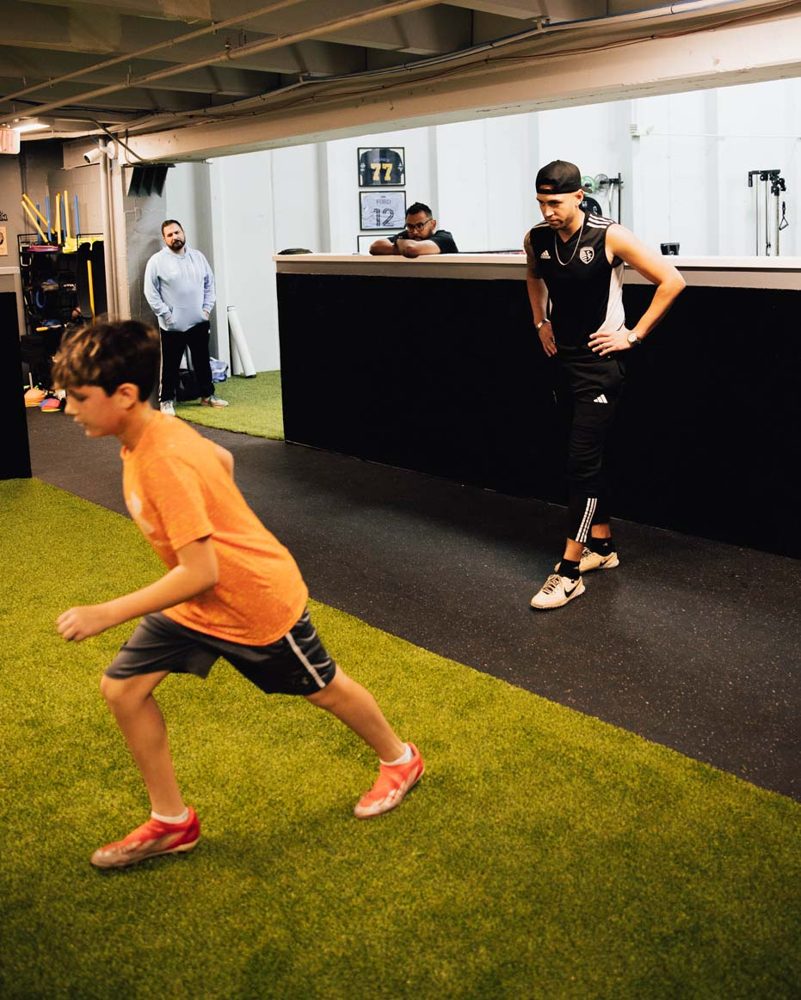
At Prestige Indoor Sports, our coaches use small-sided games and futsal-style sessions to pile up touches and put kids in constant decision-making situations, which is the fastest route to real improvement. You can see how it fits your child through our indoor soccer training options, or reach out on our sign-up page. Here is the honest bottom line. If your kid plays soccer and you want them to get meaningfully better, more touches is the answer, and no format delivers touches like futsal.
Key takeaways
- Futsal is a five-a-side indoor game with a small, low-bounce ball on a court the size of a basketball court.
- Players get up to 600% more ball touches than in outdoor soccer, which is the core reason it builds skill so quickly.
- It develops close control, faster decision-making, confidence for quieter kids, and explosive agility.
- The prime development window is ages 6 to 12, though all ages benefit.
- Indoor futsal runs year round, which is ideal for staying sharp through Kansas City summers and winters.
Frequently Asked Questions
What is the difference between futsal and indoor soccer?
Futsal is played on a hard court with a smaller, low-bounce ball and no walls, so the ball goes out of bounds like in outdoor soccer. Traditional walled indoor soccer is often played on turf with boards that keep the ball in play. Futsal emphasizes technical control and quick passing on the ground, while walled indoor tends to be faster and more physical. For pure skill development, futsal is the stronger choice.
Is futsal good for young soccer players?
Yes. Futsal is one of the best development tools available because it delivers a huge volume of ball touches under game pressure. It sharpens close control, decision-making, and confidence, and those skills transfer directly to the outdoor game. Many of the world's top players credit futsal for their technical foundation.
What age should a child start playing futsal?
Children can start as early as 5 or 6, and the ideal skill-building window runs through about age 12. Younger players benefit from constant ball involvement, while older kids and teens use it to refine their touch. It works alongside outdoor soccer rather than replacing it.
Do you need special shoes for futsal?
Yes, futsal is played in flat-soled indoor court shoes, not cleats. Cleats are built for grass and can be unsafe and ineffective on a hard court. A pair of flat rubber-soled indoor shoes gives kids the grip and feel they need for the surface.
Where is Prestige Indoor Sports located?
We are at 7373 W 107th St, Overland Park, KS 66212, in the heart of Johnson County, an easy drive for families from Overland Park, Olathe, Leawood, Lenexa, Prairie Village, Shawnee, and the wider Kansas City metro. Call (913) 568-8145 or use our contact page to book a session or ask which program fits your player.
Prestige Indoor Sports | Kansas City Metro Area | (913) 568-8145 | 7373 W 107th St, Overland Park, KS 66212
Ready to Get Started at Prestige Indoor Sports?
Book a free assessment with a Johnson County coach and put a real plan behind your player's development.