
Quick answer
Kids can start playful speed and agility work around age 6. The NSCA recommends adding coached work in the stage before the growth spurt, roughly ages 6 to 8 for girls and 7 to 9 for boys. A second window opens after the spurt, when strength gains drive speed. Before age 6, play is enough.
A seven-year-old and a sixteen-year-old can both be the fastest player on the field. They should almost never train that speed the same way. One is still learning how to run, stop and turn. The other is learning how to load a body that changes every month.
So at what age should kids start speed and agility training? The honest answer is a range, not a single birthday. Below is where the National Strength and Conditioning Association (NSCA) and the American Academy of Pediatrics (AAP) land, what the work looks like from age 5 to 18, and how to tell when your child does not need a program at all.
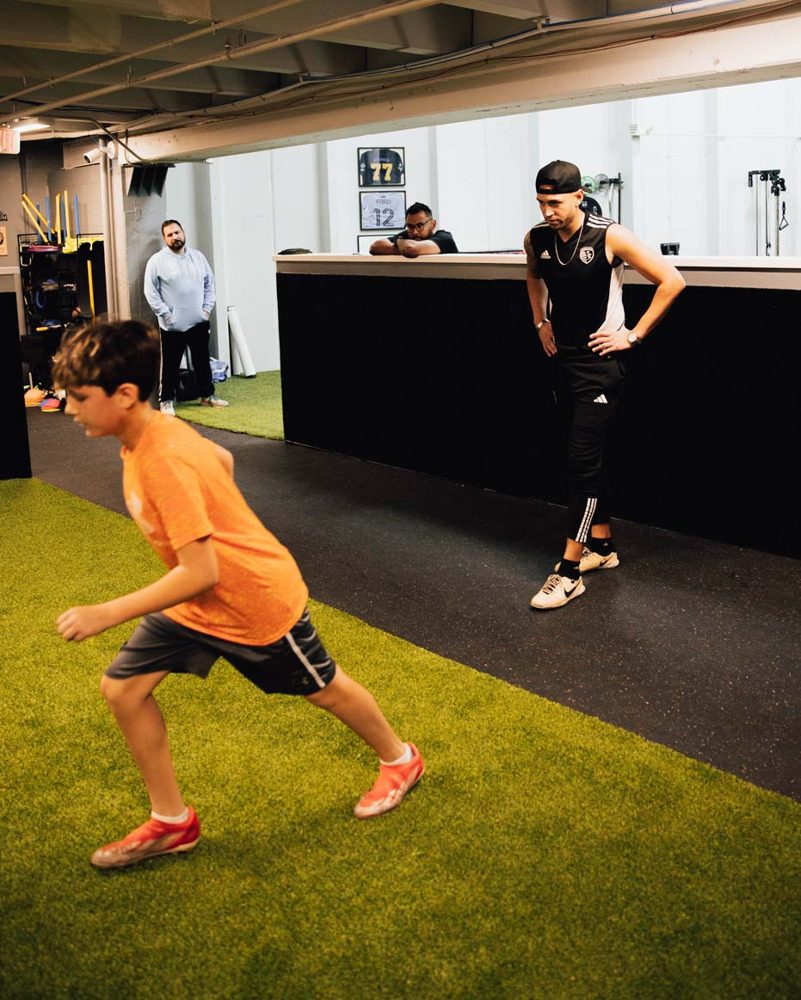
At what age should kids start speed and agility training?
Playful speed and agility work can start around age 6, and before that, ordinary play already counts. The NSCA, the group that certifies strength coaches, recommends adding coached speed and agility work before the adolescent growth spurt, which it frames as roughly ages 6 to 8 for girls and 7 to 9 for boys. The reason is timing: speed tends to dip during and after the growth spurt, so skills built earlier soften the drop.
Speed and agility are two different things. Speed is how quickly you cover ground in a straight line. Agility is how well you change direction, stop and restart, ideally in response to what is happening around you. Soccer asks for both, over and over, in bursts of a few seconds.
Age is only half the picture. The AAP points out that it is not age alone that determines training participation. A child with more experience and better technique has an older "training age" than a beginner of the same age. In practice, a coach should judge readiness by how your child moves and whether they enjoy it, not by the number on the birthday cake.
What should speed work look like at your child's age?
Pick an age group. The answer includes the honest version, which is that sometimes the right amount of formal training is none.
Choose an age group to see the plan.
Why the growth spurt changes the plan
The growth spurt is the biggest reason a one-size-fits-all speed plan fails. The NSCA's guidance, drawn from the book Developing Agility and Quickness, says speed has been shown to decrease during and following peak height velocity, the fastest stretch of the growth spurt. Limbs lengthen before muscles reach full size and strength, and motor skills can slip. Parents call it the awkward phase. The NSCA calls it adolescent awkwardness.
That is why the NSCA describes two windows. The first comes before the spurt, when body control and form are the priority. The second comes after it, when hormones drive a jump in strength, and strength is closely tied to speed, change of direction and jumping ability. The stretch in between is the time to slow down, not push harder.
Two windows with a growth spurt in between
A sequence, not a calendar. Growth spurts arrive at different ages for different kids.
Window one
Before the growth spurt
The NSCA recommends adding speed and agility here: roughly ages 6 to 8 for girls and 7 to 9 for boys. Body control and form come first.
The spurt
Slow down and polish
Speed can dip, coordination feels off and injury risk may rise. Spend the time on movement quality and lighter loads.
Window two
After the growth spurt
Strength gains drive speed and change of direction. Heavier, faster and more specific work now pays off.
Source: NSCA Kinetic Select, "Age and Sex Considerations: Practical Application" (December 2023).
Myth
Speed training means sprint drills and heavy lifting, so it is only for older kids.
Fact
The AAP says children as young as 5 can build strength with one-legged hops and frog jumps. Early work is movement quality, done with supervision and good technique.
Myth
If a growth spurt has made my child slower, they need to train harder to catch up.
Fact
The NSCA says coaches may spend more time reviewing optimal movement patterns during adolescent awkwardness, with reduced loads. Form first, then speed.
What speed and agility training looks like at each age
These are coaching guidelines built on the NSCA and AAP guidance above, not a rulebook. Every child moves and grows differently, so treat the age bands as a starting point.
Ages 5 to 7: play is the program
No formal training is needed. Chase games, hopping, bounding, balancing on one leg and kicking a ball around build the raw movement skills. If your child is on a team, practice and games already deliver plenty. The goal is that they love moving.
Ages 8 to 10: learn to run, stop and turn
This is where short, coached sessions start to make sense, because it lines up with the early window the NSCA describes. Good work at this age is playful and technical: sprint starts from odd positions, cutting both directions around cones, and stopping under control. Stopping is the underrated half of speed.
Ages 11 to 14: form first through the growth spurt
Bodies are changing fast, so a coach's eye matters more than a hard workout. Expect acceleration and landing mechanics to be rebuilt, bodyweight strength added with careful technique, and total volume kept modest. If your child suddenly looks clumsy, that is normal, and it is a reason to back off, not push.
Ages 15 to 18: strength meets speed
Once the spurt has passed, strength starts to carry speed. This is the stage for resisted sprints, progressive jump training, reactive agility against a live opponent and repeat-sprint conditioning. It is also the stage where overload sneaks in, because club, school and weights all compete for the same legs.
Not sure what fits your player?
Tell us their age and what they play. A Prestige coach will reach out to help you get started. No payment now.
Where can my teenage athlete train speed and agility in Overland Park?
Choose a program where a coach watches your teen move and corrects what they see, not one that just times sprints and counts reps. A good local option does four things well, and you can check each one before you pay for a session.
- A coach who coaches movement. Ask who watches form during sprints, cuts and landings, and how often they step in.
- Plans that flex with growth. A teen who grew three inches since spring should not run the same session as before.
- Stopping and landing, not only sprinting. Deceleration and landing control are where speed is won and lost.
- Rest built in. Ask how the plan fits around club, school sports and weights, and where the rest days go.
Prestige Indoor Sports trains at 7373 West 107th Street in Overland Park. Its speed and agility training builds acceleration, deceleration, change of direction and conditioning with soccer-specific drills, tailored to each athlete's age and stage, with safe, sound movement first and explosiveness after. Speed and agility can also be added to any private, semi-private or group session. For a deeper look at how it fits soccer, read our guide to soccer speed and agility training near Overland Park. If you would rather work one on one, we also break down whether private soccer lessons are worth it.
How often should kids do speed and agility work?
Less often than most parents expect, and always with rest. The AAP's guidance on burnout in young athletes offers a simple ceiling: kids should not train more hours each week than their age. It also advises 1 to 2 days of rest every week and at least 2 to 3 months off during the year.
Speed is a quality skill. Sprinting and cutting at full effort only trains the nervous system when the legs are fresh, so a short, sharp session beats a long, tired one. Add it on top of an already full week and you risk the reverse of what you wanted. Our guide to how often youth soccer players should train walks through the weekly math by age.
When your child does not need a speed program yet
Many kids do not need one, and a good coach will tell you so. Skip it for now if your child is under 8 and already plays freely, if they are in the middle of a growth spurt and visibly tired, if their week is already full of club, school and games, or if they simply do not enjoy it. The AAP defines burnout as kids no longer feeling a sense of fun and accomplishment, and an add-on program is the quickest way to cause it.
The better first step is often more play, more sleep and more games. Come back to formal speed work when your child is curious about it, has the time, and the body is ready for it.
Key takeaways
- Playful speed and agility work can start around age 6. Before that, play is the training.
- The NSCA's early window is roughly ages 6 to 8 for girls and 7 to 9 for boys, before the growth spurt.
- Speed can dip during and after the growth spurt. Use that stretch for form and lighter loads.
- A second window opens after the spurt, when strength gains drive speed and change of direction.
- Keep it short and rested: no more weekly hours than age, and 1 to 2 rest days every week.
- If your child is under 8, growing fast, overloaded or not enjoying it, waiting is a good plan.
Frequently asked questions
At what age can a child start speed and agility training?
Playful work can start around age 6, and for younger children play already counts as training. The National Strength and Conditioning Association recommends adding coached speed and agility work before the growth spurt, roughly ages 6 to 8 for girls and 7 to 9 for boys, with form as the priority.
Is speed and agility training safe for kids?
It is safe when it is coached, technique comes before speed, and rest is built in. The American Academy of Pediatrics says children of all ages can benefit from resistance training with proper supervision, and the same principles apply to speed work: qualified coaching, clean form, and no jumping straight to maximal effort.
Is speed and agility training different for girls and boys?
The timing is different because growth spurts arrive at different ages. The NSCA's early window is roughly 6 to 8 for girls and 7 to 9 for boys, and it notes that girls face a higher risk of knee injury when body size outpaces hip and knee strength, so strength and landing mechanics deserve extra attention.
How often should kids do speed and agility training?
Less often than most parents expect. The AAP advises that kids should not train more hours each week than their age, with 1 to 2 rest days every week and at least 2 to 3 months off over the year. Speed work needs fresh legs, so short, rested sessions beat long, tired ones.
Where can my teenage athlete train speed and agility in Overland Park?
Look for a program where a coach watches movement and corrects form, adjusts for growth, trains stopping and landing as well as sprinting, and builds in rest days. Prestige Indoor Sports offers soccer-specific speed and agility training at 7373 West 107th Street in Overland Park, tailored to age and stage.
Keep reading
Speed and Agility Training in Overland Park
Soccer-specific acceleration, deceleration and change-of-direction work, tailored to your player's age and stage.
See the program →Soccer Speed and Agility Training Near Overland Park
Where speed actually wins matches, and how to tell whether your player is ready for it.
Read the guide →How Often Should Youth Soccer Players Train?
The weekly ceiling, the rest days that matter, and the signs of too much.
Read the guide →Ready to find the right speed work for your player?
Tell us their age and what they play. A Prestige coach will reach out to help you get started. No payment now.