
Picture the moment. A ball squirts loose at midfield in a tight Johnson County tournament, two players are equidistant, and one of them gets there first. That first explosive step often decides who attacks and who defends. It is easy for a parent watching from the sideline to assume their kid is just "not fast." The truth is more hopeful than that. First-step quickness, change of direction, and the ability to keep sprinting in the 80th minute are all trainable skills. They respond to the right work the same way passing and shooting do. If your player keeps getting beaten to the ball or loses footing on hard cuts, you do not need a faster kid. You need soccer-specific speed and agility training, and you can find it close to home.

At Prestige Indoor Sports in Overland Park, we coach speed the way it actually shows up in a match, not the way it shows up in a generic gym. Below you will find an honest look at where speed wins games, a quick readiness check for your own player, and a stage-by-stage map of what to train and when. Take a few minutes with it. By the end you will know whether your son or daughter is ready to book and what to expect when they walk through our doors.
Why generic gym speed work misses the point for soccer
There is a difference between being a fast runner and being a fast soccer player. A straight-line sprint rewards a long, smooth top gear. A match asks for something different. Soccer is stop, start, plant, cut, accelerate, decelerate, repeat, usually while reading the ball and an opponent at the same time. A player can be the quickest sprinter on the team and still arrive late to loose balls because their first few steps are slow and their cuts are sloppy.
What soccer speed actually demands
When we build a session, we are training four things that map directly to game moments:
- First-step acceleration. Beating an opponent to a 50/50 ball or breaking off the mark before a defender reacts.
- Change of direction. Planting hard and exploding the other way to shake a marker or recover position.
- Deceleration and balance. Stopping under control so you do not overrun the ball or get spun. It is easy to overlook, so we coach it on purpose.
- Repeated-sprint endurance. The ability to make that explosive run in the 80th minute as cleanly as in the 5th.
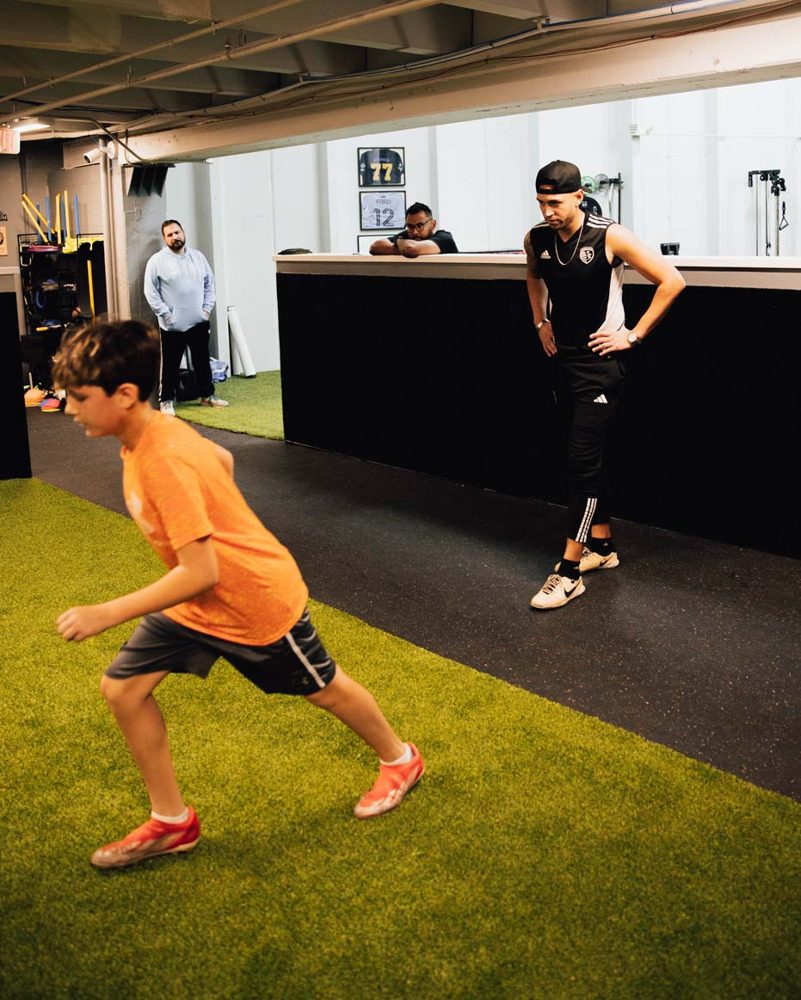
Generic agility-ladder drills can look busy and feel productive, but fast feet through a ladder only help in a game if a player also learns to brake, reposition their hips, and reaccelerate with a ball in play. Our speed and agility training in Overland Park is built around those real demands, with coaches who actually watch how each kid moves and fix the mechanics underneath the speed.
Notice what is on that list. Raw top speed is not the headline. It is the first step and the cut, moments that come up again and again in a match. Train those, and a player can feel the difference across the field, not just on a breakaway.
Coach's tip: Quick feet are not the goal. Quick feet that arrive somewhere useful are the goal. We always pair acceleration work with a soccer decision so the speed sticks in a game, not just on the turf.
Is your player ready for speed and agility training?
Speed and agility training fits best when a player has reached the stage where their body can take it and their game can use it. The focus shifts as kids grow, and a coach should assess movement before prescribing anything. The quick self-check below is the same lens we use during a first session. Tick the boxes that sound like your kid.
Tick every box that describes your player. The verdict updates as you go.
Tick the boxes that describe your player to see where they stand.
The right speed work at the right age
A program that trains every kid the same way regardless of age misses something important. A nine-year-old and a fifteen-year-old need very different emphasis. Coordination and clean movement come first. True power and top speed are layered on later, once the body is ready. Tap through the stages below to see what we prioritize and why.
Pick a stage to see what matters now.
This lines up with an NSCA article excerpted from the book Developing Agility and Quickness, which recommends introducing speed and agility training in the earlier prepubescent years (it lists ages 6 to 8 for girls and 7 to 9 for boys), with attention first on body awareness, body control, and proper movement mechanics. It also describes a second window after the adolescent growth spurt, when gains in strength support further improvement in speed and agility. If you are not sure where your child fits, that is exactly what a first session sorts out. Our coaches assess movement before they prescribe anything, so a younger player is never pushed into work their body is not ready for, and an older player is never stuck repeating drills they outgrew. You can read about the people who run these sessions on our coaches page.
Not sure if your player is ready?
Send us their age and what you are seeing on the field. We will tell you honestly.
Why indoor training is the quiet advantage
Here is the part Kansas City parents know well. Winters are cold, springs can flood the fields, and summer heat can shut outdoor sessions down. Outdoor speed programs can lose sessions to weather, and lost sessions are lost reps. Speed is built through consistent, repeatable reps, and it is hard to build in stops and starts.
Training indoors at our Overland Park facility removes that variable entirely. The surface is the same every time, so a player's footing, plant, and cut are consistent rather than dependent on whether the grass is wet or the lot is icy. Sessions never cancel for weather, which means a twelve-week block is actually twelve weeks. That reliability is a bigger deal than it sounds. For the bigger picture on kids and activity, the CDC's physical activity page for children says children and adolescents 6 to 17 need to be active for at least 60 minutes every day.
What a session at Prestige looks like
No fluff, no busywork. A typical speed and agility session moves through a deliberate warm-up that prepares the joints and nervous system, then into the day's focus, whether that is first-step acceleration, cutting mechanics, or repeated-sprint conditioning. We coach technique out loud, correct in real time, and tie the movement back to a soccer moment so the brain links speed to the game. Players leave knowing what they worked on and what got better.
Who it is for
Players from Overland Park, Olathe, Leawood, Lenexa, Prairie Village, Shawnee, and across the Kansas City metro train with us. Club players use it to keep an edge, rec players use it to make the jump to competitive teams, and tryout-bound players use it to show their best when it counts. Families can pair speed work with our other programs, since a faster player who also has sharp touches is a tough matchup. If touch and technique are also on your list, our private soccer training sessions stack naturally with speed work.

Give your player a faster first step
Soccer-specific speed and agility training, year-round and weatherproof, right here in Overland Park. The best time to start is now.
Frequently Asked Questions
At what age should my child start soccer speed and agility training?
Age matters less than readiness, and the focus changes as kids grow. An NSCA article recommends introducing speed and agility training in the earlier prepubescent years, listing ages 6 to 8 for girls and 7 to 9 for boys, with attention first on body awareness, body control, and clean movement. Younger kids work on coordination, balance, and clean movement through games, while true speed and power are layered in during the teen years once the body is ready. Our coaches assess each child first and start them at the right stage rather than pushing one-size-fits-all drills.
How is soccer speed training different from regular gym or track work?
Track and general gym work tend to reward long, straight-line top speed. Soccer asks for something different. A match is built on first-step acceleration, hard cuts, deceleration, and repeated short sprints, usually while reading the ball and an opponent. Our sessions train those specific demands and tie every rep back to a game situation, so the speed actually shows up on the field.
Where is your speed and agility training located near Overland Park?
Our facility is at 7373 W 107th St, Overland Park, KS 66212, in the heart of Johnson County. We are an easy drive for families from Overland Park, Leawood, Lenexa, Olathe, Prairie Village, Shawnee, and the wider Kansas City metro. You can reach us at (913) 568-8145 or through our contact page to book a session or ask which program fits your player.
How quickly will I see my child get faster?
Every player is different, so we cannot promise a timeline. Speed and agility are skills that improve with consistent, age-appropriate training, and clean movement mechanics are often the first thing a coach works on, while raw power builds over time. The biggest factor is consistency, which is exactly why training indoors year-round, with no weather cancellations, helps.
Do you have to be on a club or competitive team to train?
Not at all. We work with club players keeping an edge, rec players trying to make the jump to competitive teams, and players preparing for tryouts. The training meets each player where they are. If your child loves soccer and wants to win more battles on the field, they are a good fit, regardless of what team they currently play for.
Related reading: At what age should kids start speed and agility training?
Prestige Indoor Sports | Kansas City Metro Area | (913) 568-8145 | 7373 W 107th St, Overland Park, KS 66212
Ready to Get Started at Prestige Indoor Sports?
Book a free assessment with a Johnson County coach and put a real plan behind your player's development.